
'The biggest lacuna in this agreement is it is called 'full civil nuclear cooperation agreement.' Actually, it is anything but full.'
'The real story of 2025 is that India officially stopped being a 'market of the future' and started acting as the world's primary economic engine.'

'Geopolitically and diplomatically it's a very difficult situation for India.'

The Bharatiya Janata Party and the Left parties have already indicated opposition to the Civil Liability for Nuclear Damage Bill that is key to operationalise the landmark Indo-US nuclear deal. The Bill pegs the maximum amount of liability in case of each nuclear accident at Rs 300 crore to be paid by the operator of the nuclear plant.
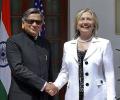
US Secretary of State Hillary Clinton after the second round of Indo-US Strategic Dialogue with her counterpart S M Krishna, made it very clear that there were "issues" which required to be resolved by the two sides in the civil nuclear field. But she did not go into the specifics.
Facing stiff opposition over the Nuclear Liability Bill, the government on Friday said it will consult all political parties before tabling the draft legislation in Parliament. "
As a Parliamentary panel races to submit its report on the nuclear liability bill, Bharatiya Janata Party appears to have dug its heels asking the government to clarify whether the draft legislation was India-specific or being enacted to fulfil requirements of international treaties.
The Parliamentary panel examining the controversial nuclear liability bill is expected to finalise its report in time for introduction of the draft legislation during the monsoon session beginning July 26. The Parliamentary Standing Committee on Science and Technology, Environment on Forests is examining the Civil Liability for Nuclear Damage Bill, 2010 that was introduced in the Lok Sabha on May 7 amid stiff resistance from a united Opposition.
'If we could break through this symbolic barrier of sanctions and a dysfunctional relationship, we could do anything.'
United States Ambassador to India Timothy J Roemer on Monday called on Bharatiya Janata Party president Nitin Gadkari and is understood to have discussed the nuclear liability bill, which is being opposed by the party. Sources said Roemer called on Gadkari to discuss the Civil Liability for Nuclear Damage Bill and allay apprehensions expressed by the BJP about the proposed legislation. BJP is opposing the Bill.
Modi has made nuclear power a key element of his clean energy strategy
From bhikshus of Ashokan 3rd century BC and medieval Sufis to Oxfam, Omidyar and Soros now, non-State actors have any real power only when they work in conjunction with a real State, asserts Shekhar Gupta.

Whether the ambitious targets are achievable is a moot question as India's earlier target was 20,000 MW of nuclear power by 2020.
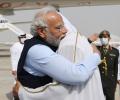
Prime Minister Narendra Modi will visit Abu Dhabi on July 15.
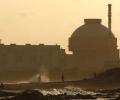
The Indian Nuclear Energy Pool, meant to insure risks from nuclear reactors, may take longer to be set up. While the idea of forming a pool was mooted earlier this year, it has reached a deadlock owing to differences among the stakeholders on certain clauses.
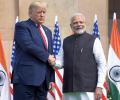
Prime Minister Narendra Modi will pay a two-day working visit to the US from February 12 during which he will meet President Donald Trump, the external affairs ministry announced. The visit will give further impetus and direction to India-US bilateral relationship. Prior to his US visit, Modi will be in France from February 10-12 to co-chair the AI Action Summit with French President Emmanuel Macron. He will also visit Cadarache, the site of the International Thermonuclear Experimental Reactor of which India is a partner. During his visit to France from February 10-12, Modi and Macron will also address the India-France CEOs forum. The prime minister and Macron will travel to Marseille where they will inaugurate the Consulate General of India. The leaders will also visit the war cemetery and pay tribute to the sacrifices made by Indian soldiers in World War 1. Modi and Macron will visit Cadarache, the site of the International Thermonuclear Experimental Reactor (ITER). There has been a very close rapport between Trump and Modi, dating back to the US leader's first term. There is a clear convergence of interests between the two countries in several areas, including trade, investment, technology, defense cooperation, counterterrorism, Indo-Pacific security, and people-to-people relations.

On the final day of Prime Minister Narendra Modi's visit to the US, that country on Tuesday extended its Defence Cooperation Agreement with India by another 10 years. The pact, which was to expire in June next year, will now be in force till 2025.
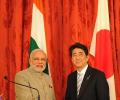
The "understanding" between India and Japan on civil nuclear issue has "improved", Prime Minister Narendra Modi said on Monday, after talks with his counterpart Shinzo Abe even as the much-anticipated remained deal remained elusive.
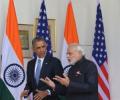
It is for the companies and the industry to ascertain where they want to run with the US-India civilian nuclear agreements reached by Washington and New Delhi, says United States Assistant Secretary of State Nisha Biswal. Aziz Haniffa reports for Rediff.com from Washington, DC
While the capital spending is being maintained at 3.1 per cent of the GDP, a little more would have boosted economic growth even further, suggests Rajiv Memani.
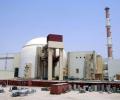
The contract would give a big boost to India's $150 billion nuclear power programme, and a broader push to curb greenhouse gas emissions.
Getting the requisite numbers to pass the Civil Liability for Nuclear Damage Bill 2010 in the Lok Sabha may be the least of the United Progressive Alliance's problems. Lawyers and legal experts, including those who support the legislation, say there are many instances of poor drafting and anomalies that have the potential to generate more controversy if the Bill is passed in its current form.

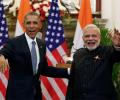
Prime Minister Narendra Modi and US President Barack Obama on Sunday held talks on a range of crucial issues, including removing hurdles in operationalising the long-stalled civil nuclear agreement and enhancing ties in defence, trade and commerce and climate change.

Posing a series of questions to the prime minister, Congress general secretary in-charge communications Jairam Ramesh also asked if Modi would convey to the US president that India would send its own aircraft -- like Venezuela and Colombia did -- to bring back Indian deportees in the future.
The reality is that far from being friendless, India is better positioned in the world than at any point post-Cold War, asserts Shekhar Gupta.
The Supreme Court on Friday sought the government's reply to a plea challenging various provisions of the controversial Civil Liability on Nuclear Damage Act.

'There has definitely been a breakthrough in the nuclear logjam. It is good to see nuclear energy back on the rails,' says Dr Anil Kakodkar, former chairman, Atomic Energy Commission.
BJP president Rajnath Singh has said that if the party comes to power in the next general election, its foreign policy wouldn't be much different from that of the Congress government. Aziz Haniffa in Washington
About 4 GW of new nuclear power capacity is under construction in India

In first high-level engagement between India and Russia after National Democratic Alliance government came to power, External Affairs Minister Sushma Swaraj and Russian Deputy Prime Minister Dmitry O Rogozin on Wednesday held extensive talks on crucial bilateral issues including trade and energy security.
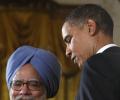
Prime Minister Manmohan Singh departed for an official visit to the United States on Wednesday morning in what could be a last opportunity to recover his crumbling legacy. A host of issues are tied to what could be accomplished on this trip; that the stakes are high is evident from how carefully the government is downplaying whether or not anything can be accomplished.

The Congress will take on the government in Parliament on the Indo-US nuclear deal
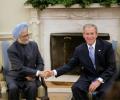
'The nuclear deal required Prime Minister Manmohan Singh to gamble the future of his government on a vision for the future of his nation.'

US President Barack Obama left for Saudi Arabia on Tuesday.

Ahead of Russian President Vladimir Putin's India visit, the United States has said it would not impact President Barack Obama's trip to the country in January but warned now was not the right time to do business with Russia.

United States President Barack Obama on Sunday arrived in India for a highly anticipated three-day landmark trip during which the two countries will strive to make progress on climate change, defence and economic cooperation.
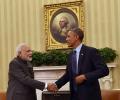
Furthering Indo-US cooperation on terrorism, Prime Minister Narendra Modi and President Barack Obama on Tuesday agreed to make "joint and concerted efforts" to dismantle safe havens for terror and criminal networks like Lashkar-e-Tayib, Jaish-e-Mohammad, Dawood-company, Al Qaeda and the Haqqani network.

Narendra Modi's positive engagement with Barack Obama has well and truly washed away the doubts and slights of the past.

India is expected to strongly push for a bilateral totalisation agreement with the US during President Barack Obama's visit later this month.
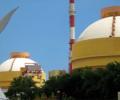
Legal hitches appear to have cropped up in the plans to set up two new reactors in the Kudankulam Nuclear Power Project and a commercial agreement on it is unlikely to be signed at the Annual Summit between Prime Minister Manmohan Singh and Russian President Vladimir Putin in Moscow on Monday.
